
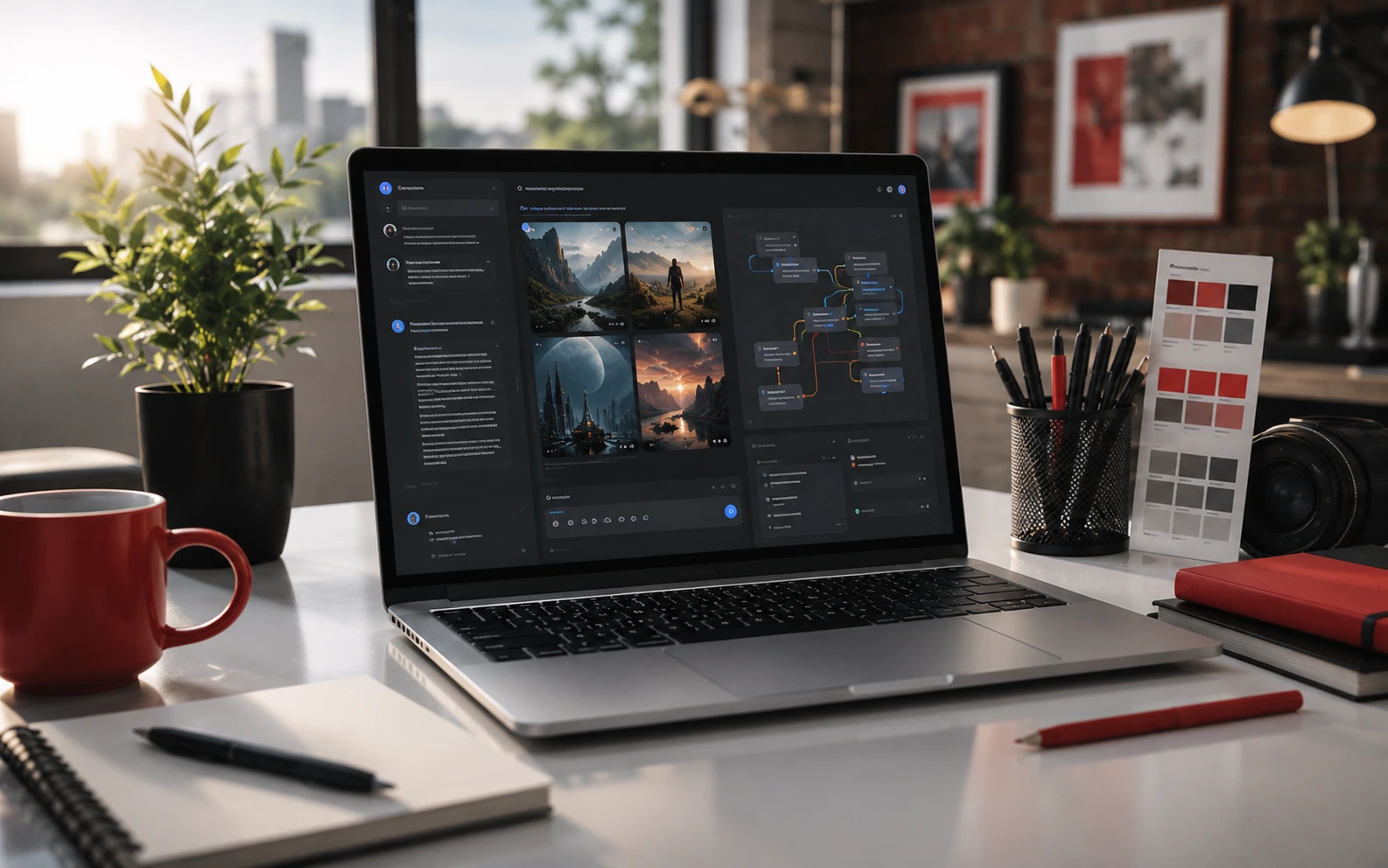
The technology trends of 2026 are not distant future possibilities — they are live, accelerating forces that are already reshaping industries, changing job requirements, and creating new competitive dynamics. Businesses that identify these trends early and adapt accordingly will capture opportunities; those that ignore them will find themselves displaced by more agile competitors. This guide covers the most significant technology trends every business leader should be tracking.
Generative AI Goes from Novelty to Infrastructure
Generative AI — the category of AI that creates text, images, code, audio, and video from natural language prompts — has moved from an interesting experiment to core business infrastructure in 2026. What ChatGPT demonstrated as a consumer novelty in 2022 is now embedded in productivity suites, development tools, marketing platforms, customer service systems, and business intelligence dashboards.
The competitive implication for businesses is stark: organisations that have integrated AI into their workflows operate with a productivity multiplier that manual-process competitors cannot match on price or speed. The question for business leaders in 2026 is not whether to adopt AI but which workflows to automate first and how to develop internal AI literacy across the team.
Agentic AI — systems where AI agents autonomously plan and execute multi-step tasks with minimal human oversight — is the next wave, moving from prototype to early enterprise deployment in 2026. Rather than AI responding to individual prompts, agentic systems initiate, plan, and execute complex sequences of actions on behalf of users.
Edge Computing and the Intelligent IoT
Edge computing moves data processing from centralised cloud data centres to devices and local infrastructure closer to where data is generated. The combination of edge computing and artificial intelligence is enabling a new generation of applications that require real-time responsiveness: autonomous vehicles, industrial automation, smart city infrastructure, and precision agriculture.
For South African businesses, edge computing has particular relevance as a mitigation strategy for unreliable connectivity. Processing data at the edge reduces dependence on consistent internet connectivity, making edge-enabled applications more resilient in an environment where load shedding and connectivity disruptions remain operational challenges.
Quantum Computing Approaches Commercial Viability
Quantum computing remains largely in research and early enterprise experimentation in 2026, but progress is accelerating. IBM, Google, and a growing number of specialised startups have demonstrated quantum systems with increasing qubit counts and error rates approaching the threshold needed for practical business applications.
The near-term commercial impact will be felt first in specific domains: pharmaceutical drug discovery, financial portfolio optimisation, logistics and supply chain optimisation, and materials science research. For most businesses, the quantum computing trend matters primarily because it will eventually break current encryption standards — creating an urgency for quantum-resistant cryptography adoption that security teams need to plan for now, even if the timeline to threat is still years away.
Spatial Computing and Extended Reality
The launch of Apple Vision Pro and the continued development of enterprise AR/VR platforms has moved spatial computing from science fiction to early commercial adoption in 2026. Applications gaining traction include remote expert assistance (an expert guiding a field technician through a repair via AR overlay), training simulations for high-risk environments, virtual product demonstrations for retail and real estate, and immersive collaboration spaces for distributed teams.
Cybersecurity Becomes AI-First
The cybersecurity landscape in 2026 is defined by the AI arms race between attackers and defenders. AI is enabling attackers to generate more convincing phishing content, discover vulnerabilities faster, and create polymorphic malware that evades traditional detection. In response, security vendors are deploying AI-powered detection, response, and threat intelligence platforms at a scale that was previously impossible.
Zero Trust Architecture — the security model that assumes no user or system is inherently trusted and requires continuous verification — is becoming the standard for enterprise security design, replacing the traditional perimeter-based model that is increasingly ineffective against modern threats.
Green Technology and Sustainable Innovation
Environmental sustainability is increasingly a technology investment priority, driven by regulatory pressure, customer expectations, cost economics, and genuine corporate responsibility. Energy-efficient AI chips, carbon-aware cloud computing, renewable energy-powered data centres, and circular economy platforms are all growing technology categories.
For South African businesses, sustainable technology investment intersects with energy security. Businesses investing in solar power, energy storage, and smart energy management are simultaneously reducing their operational costs, improving their resilience against load shedding, and strengthening their environmental sustainability credentials.
What Business Leaders Should Do
Identify the one or two trends most directly relevant to your industry and competitive position. Assign a team member to monitor developments in those areas. Pilot small, low-risk experiments before committing to major investments. Build AI literacy across your team so that individuals at every level can identify opportunities to apply AI in their specific roles. And revisit your technology strategy at least annually, as the pace of change in 2026 makes 12-month-old technology assessments potentially obsolete.