
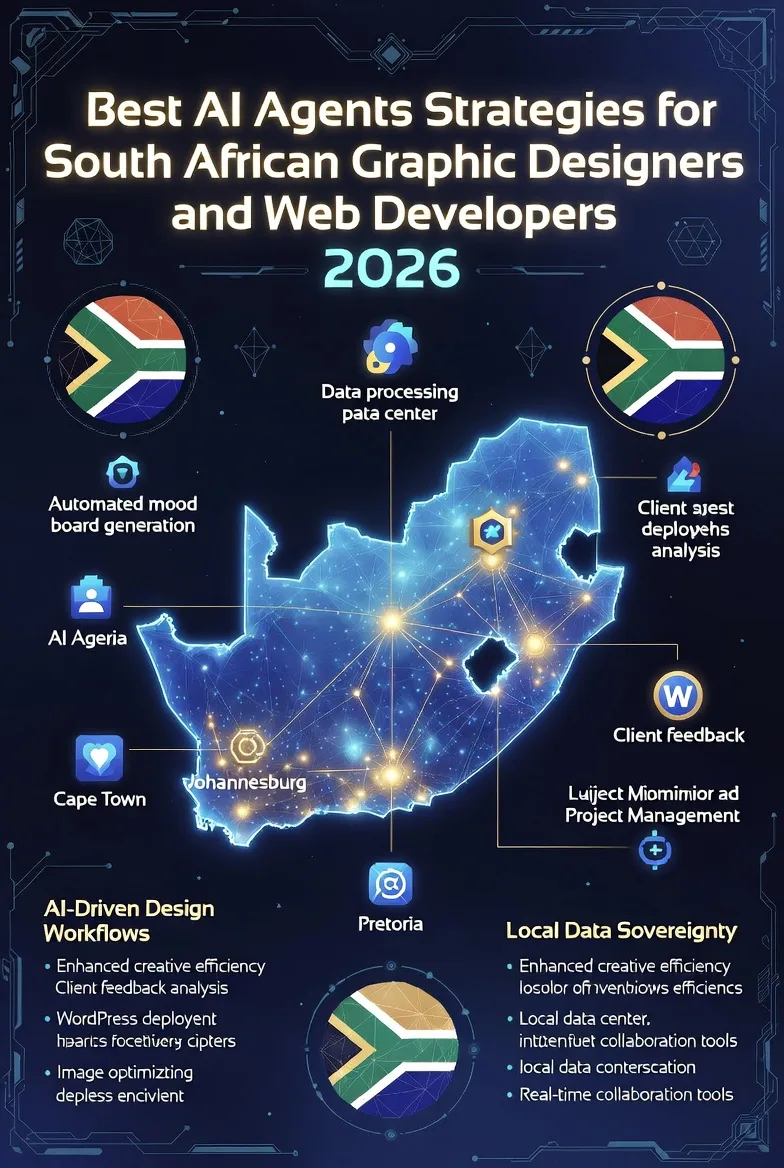
36 Revolutionary Breakthrough AI Agents Strategies Unlocking Tremendous Growth for South African Graphic Designers and Web Developers in 2026
South Africa’s creative sector is witnessing a significant shift toward more autonomous AI systems in early May 2026. With continued expansion of local cloud and GPU infrastructure from major investments, AI agents — intelligent systems that can execute multi-step tasks independently — are becoming practical tools rather than experimental concepts for many professionals.
The best AI agents strategies for South African graphic designers and web developers involve selecting the right agents, integrating them safely into existing workflows, maintaining human oversight and aligning them with local project needs. At Red Apple Connect, we’ve seen freelancers and small studios begin using agents for repetitive tasks, freeing up valuable time for strategic creativity and client relationships.
Whether you freelance in Pretoria, manage branding projects from Johannesburg or build custom WordPress solutions for clients in Cape Town and regional towns, these strategies help you harness autonomous AI while preserving the cultural insight and quality that South African audiences expect.
Why AI Agents Are Gaining Real Traction Among Local Creatives
AI agents can handle sequences of actions — such as generating design variations, analysing competitor sites, optimising assets and even drafting client reports — with minimal input. Improved local latency from recent data centre growth makes these agents more responsive and reliable. This development comes at a perfect time as freelancers and agencies look for ways to scale without proportionally increasing overheads.
Many South African creatives are moving beyond single-prompt tools to agent-based systems, and those applying the best AI agents strategies for South African graphic designers and web developers are seeing meaningful gains in productivity and project capacity.
1. Understanding Different Types of AI Agents
Start with simple task-specific agents before exploring multi-agent systems that collaborate on complex projects.
2. Selecting Agents Compatible with Creative Tools
Choose options that integrate well with Figma, Adobe Suite, WordPress and local cloud environments.
For reliable hosting that supports agent-driven deployments, see our guide to /web-hosting.
3. Setting Clear Goals and Guardrails
Define exact parameters and approval checkpoints so agents enhance rather than replace your judgement.
Discover foundational AI approaches in our post on /ai-tools.
4. Automating Repetitive Client Intake Processes
Use agents to analyse briefs, suggest initial mood boards and prepare project timelines.
For efficient scaling methods, check our article on /cloud-tips.
5. Creating Automated Design Exploration Workflows
Let agents generate multiple concepts based on your parameters, then refine the strongest options.
6. Implementing Smart Asset Management Agents
Set up systems that automatically organise, tag, optimise and version design files.
7. Using Agents for Performance Analysis
Have agents test designs across different devices and network conditions common in South Africa.
8. Streamlining WordPress Development Tasks
Deploy agents that suggest blocks, optimise code or generate accessibility reports.
9. Building Personalised Client Communication Agents
Automate follow-ups, progress summaries and basic revisions while keeping your personal touch.
10. Monitoring Project Budgets and Timelines
Use agents to track milestones, flag potential overruns and suggest adjustments.
11. Researching Market and Competitor Trends
Task agents with gathering insights relevant to South African industries and audiences.
12. Ensuring Human Oversight at Critical Points
Review all agent outputs for cultural relevance, brand alignment and emotional impact.
13. Combining Multiple Agents in Orchestrated Systems
Create workflows where one agent handles research, another generation and a third optimisation.
14. Addressing Data Privacy and Security
Only share necessary information with agents and use local or compliant infrastructure.
15. Training Agents with Your Specific Style
Feed previous successful projects so agents learn your design preferences and brand standards.
16. Integrating Agents with Local Payment Systems
Automate invoicing and basic financial tracking tailored to South African freelance realities.
17. Testing Agents Under Real Network Conditions
Validate performance on variable connections experienced across provinces.
18. Scaling Freelance Capacity Thoughtfully
Use agents to manage more projects without compromising quality or work-life balance.
19. Collaborating with Other Creatives via Shared Agents
Develop team workflows where agents assist multiple contributors across locations.
20. Measuring Return on Time Invested
Track hours saved versus quality maintained to refine your agent usage.
21. Staying Updated with Agent Platform Developments
Monitor new capabilities that align with local infrastructure improvements.
22. Creating Ethical Usage Guidelines
Establish personal rules around transparency when delivering agent-assisted work to clients.
23. Optimising for Mobile and Low-Bandwidth Users
Task agents with ensuring final outputs perform well for typical South African audiences.
24. Automating Portfolio and Personal Branding Updates
Keep your own site fresh with agent assistance while adding your latest human work.
25. Exploring Industry-Specific Agents
Look for solutions tailored to design, development or creative business management.
26. Building Custom Simple Agents
Start creating lightweight agents for your most common repetitive tasks.
27. Managing Agent Costs Effectively
Combine free tiers with paid usage for maximum value in typical project budgets.
28. Preparing for More Advanced Agent Ecosystems
Stay ready for systems where agents handle end-to-end project segments.
29. Sharing Successful Patterns Locally
Exchange effective agent prompts and workflows within South African creative communities.
30. Aligning Agent Use with Responsible AI Principles
Prioritise fairness, accuracy and positive impact in line with national discussions.
31. Using Agents for Continuous Learning
Have them summarise new tutorials, trends or tool updates relevant to your practice.
32. Integrating with Existing Design Systems
Ensure agents respect your component libraries and brand guidelines.
33. Handling Feedback and Iteration Loops
Set up agents to incorporate client comments and generate revised options quickly.
34. Maintaining Creative Control and Identity
Use agents as powerful support while keeping your unique South African perspective central.
35. Documenting Effective Agent Workflows
Create reusable playbooks so successful processes become more efficient over time.
36. Focusing on High-Value Creative Strategy
Leverage agents for execution so you can dedicate more energy to storytelling, audience connection and innovation.
External resources worth exploring include recent developments in Microsoft Azure AI agent capabilities available in South African regions, reports on the rise of autonomous agents in creative industries during 2026, practical guides to multi-agent orchestration, insights from local tech events on AI adoption for small businesses, and discussions around responsible AI agent implementation.
Practical Steps to Get Started with AI Agents
Begin your journey without overwhelm:
- Identify three repetitive tasks in your current workflow that consume significant time.
- Test one simple agent on a low-stakes project and evaluate the results carefully.
- Build a basic approval process and documentation for agent-assisted deliverables.
- Gradually expand to more complex multi-step workflows as confidence grows.
If you freelance in Pretoria or smaller towns, focus on lightweight, cloud-connected agents that work well on variable connections. In Johannesburg or Cape Town, maturing local infrastructure supports more sophisticated agent teams and real-time operations.
South African graphic designers and web developers have always combined creativity with resourcefulness — the best AI agents strategies for South African graphic designers and web developers now provide intelligent support that amplifies those qualities.
Real Experiences from South African Creatives
A graphic designer in Cape Town shared how an agent helped generate and optimise social media variations from one master design, cutting production time in half while she focused on client strategy. A web developer in Johannesburg described using agents for initial site audits and performance suggestions, leading to faster deliveries and stronger client trust.
A freelancer working with community organisations noted that thoughtful agent use for research and basic content structuring allowed deeper engagement with local stories and more impactful final designs.
These accounts show how the best AI agents strategies for South African graphic designers and web developers create genuine opportunities when combined with local knowledge and careful oversight.
Managing Common Challenges Successfully
Agent outputs can sometimes miss nuance or context — strong prompting and review checkpoints address this effectively. Costs and learning curves exist, but starting small and measuring results helps justify investment. Connectivity and infrastructure variability remain factors — hybrid approaches and offline review steps maintain momentum.
As local AI capabilities grow, many of these hurdles continue to diminish, making agent adoption increasingly accessible.
A Bright Path Forward for Creative Professionals
With expanding local infrastructure supporting more responsive AI systems, the best AI agents strategies for South African graphic designers and web developers open new possibilities for efficiency, scale and creativity. By implementing these strategies thoughtfully alongside your distinctive design skills and understanding of South African audiences, you can deliver exceptional work while building sustainable creative practices.
This evolution positions agents as valuable partners rather than replacements in the creative process.
Which AI agents or automation approaches are you experimenting with right now? What results or lessons have you experienced so far? Share your thoughts in the comments — whether you operate from Johannesburg, Durban, Port Elizabeth or anywhere across South Africa. Your stories can guide fellow freelancers and tech entrepreneurs.
If this post gave you valuable ideas for incorporating AI agents into your graphic design or web development work, please share it with other South African graphic designers, web developers, freelancers and tech entrepreneurs in your network. And subscribe to Red Apple Connect for more practical, locally relevant content on technology, WordPress, web design trends and creative tools.
Let’s continue pushing digital creativity forward by using AI agents strategically while keeping human insight, cultural relevance and responsible practices at the heart of everything we create — one intelligent workflow at a time.